Advanced RAG Architecture: Hybrid Search, Reranking and Query Optimization
Introduction
Basic RAG systems typically follow a straightforward process: convert documents into embeddings, store them in a vector database, retrieve relevant chunks and pass them to an LLM.
Although this architecture works for many applications, it can struggle with complex queries, technical terminology, exact identifiers and large knowledge bases.
Advanced RAG introduces additional retrieval and ranking strategies to improve the quality of information supplied to the language model.
1. Dense Vector Retrieval
Dense retrieval converts text into numerical embeddings that represent semantic meaning.
The user's question is converted into an embedding and compared against stored document embeddings.
This enables semantic matching even when the query and document use different words.
However, semantic similarity does not always guarantee exact relevance.
2. Sparse Retrieval
Sparse retrieval methods, such as BM25, focus on lexical matching.
They are particularly useful when queries contain:
Product codes
Technical identifiers
Names and specific terminology
Exact phrases
Unique keywords
3. Hybrid Search
Hybrid search combines dense vector retrieval with sparse keyword retrieval.
For example, a user searching for a particular database error may benefit from both semantic understanding and exact keyword matching.
The results can be combined using techniques such as Reciprocal Rank Fusion (RRF).
4. Reranking
Initial retrieval systems prioritize speed and candidate selection.
A reranking model evaluates the relationship between the query and each retrieved document more carefully.
A typical workflow:
Retrieve the top 50 candidate chunks.
Pass the candidates through a reranking model.
Reorder them based on relevance.
Select the best 5–10 chunks.
Supply the selected context to the LLM.
The numbers are illustrative and should be tuned against actual evaluation results.
5. Query Transformation
Users do not always ask questions in the format expected by retrieval systems.
Advanced RAG can use:
Query rewriting
Query expansion
Multi-query retrieval
Hypothetical document embeddings (HyDE)
Query decomposition
For example, a question about employee performance assessment could be decomposed into smaller searches about assessment criteria, performance metrics and evaluation policies.
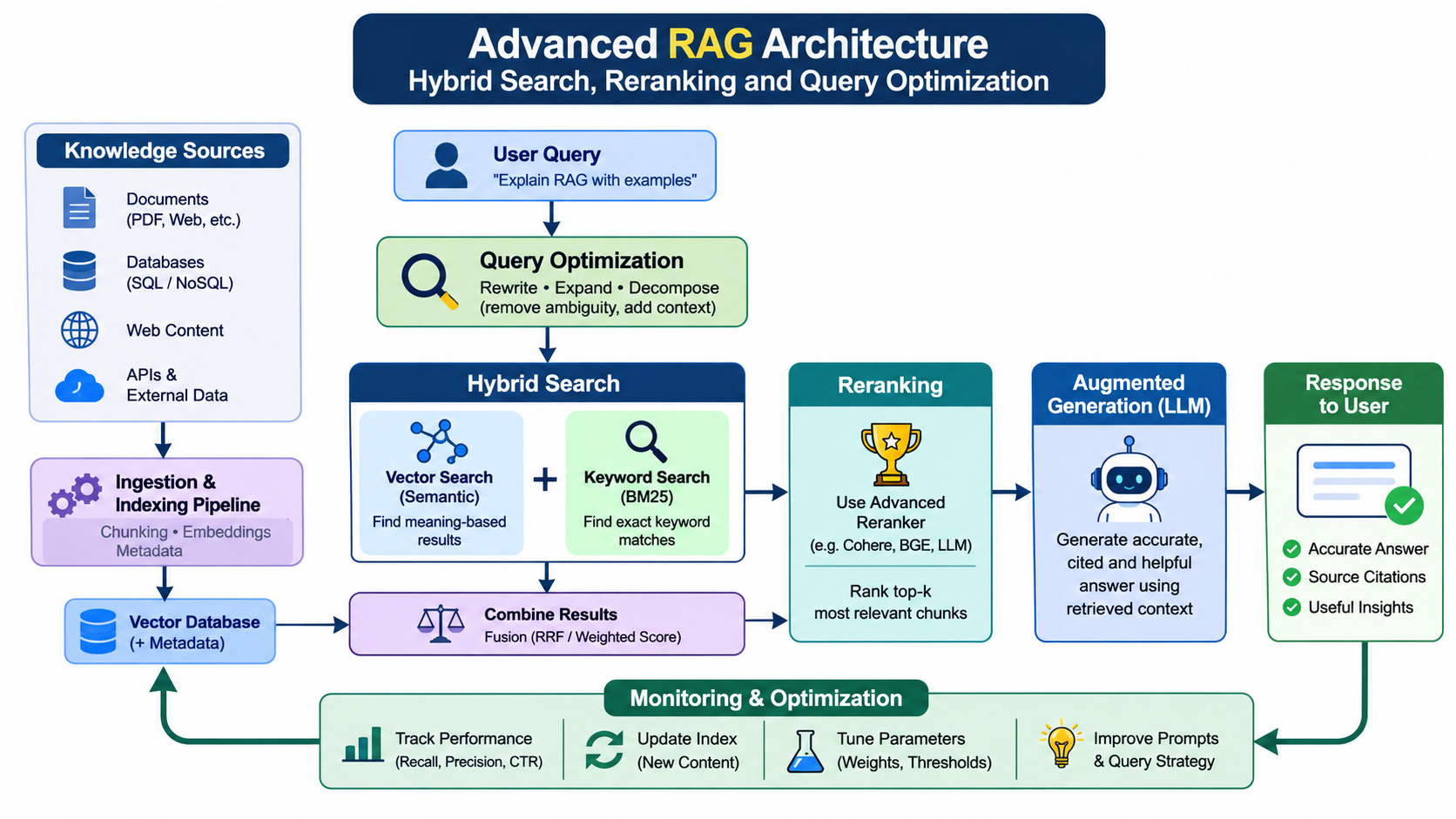
6. Putting the Architecture Together
A production-oriented advanced RAG pipeline may look like this:
User Query → Query Transformation → Hybrid Retrieval → Candidate Fusion → Reranking → Context Filtering → LLM Generation → Citation Validation.
Each stage should be independently measurable.
Conclusion
Advanced RAG is about improving the quality of information reaching the model, not simply increasing the number of retrieved documents.
Hybrid retrieval, reranking and query transformation can significantly improve retrieval quality when implemented and evaluated against real-world workloads.