Context Engineering and Intelligent Chunking: Building Better RAG Pipelines
Introduction
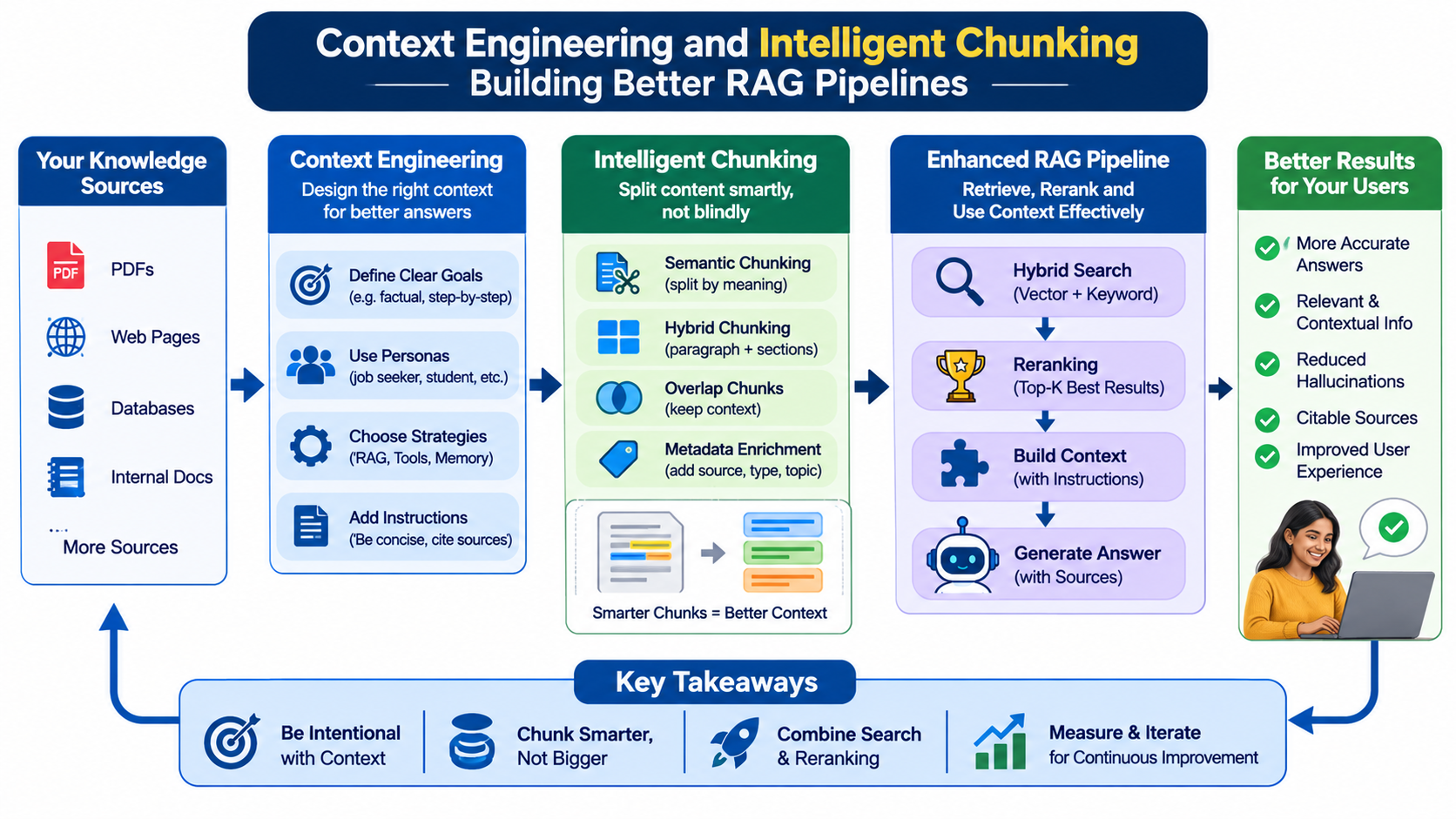
Many RAG implementations focus heavily on selecting an LLM or vector database. However, the quality of the context supplied to the model is equally important.
Even a powerful language model can generate poor responses when its context contains incomplete, irrelevant or incorrectly structured information.
Context engineering focuses on designing, organizing and managing the information available to an AI system at inference time.
Why Chunking Matters
Documents are often too large to process as individual retrieval units.
Chunking divides documents into smaller sections that can be embedded, indexed and retrieved independently.
Poor chunking can create several problems:
Important information becomes separated from its explanation.
Tables lose their relationship with surrounding descriptions.
Definitions become disconnected from their headings.
Retrieved chunks lack sufficient context.
Common Chunking Strategies
Fixed-size chunking
Splits documents based on a predefined number of tokens or characters.
It is simple and predictable but may split information at inappropriate boundaries.
Recursive character chunking
Attempts to split text using progressively smaller separators, preserving natural document boundaries where possible.
Semantic chunking
Uses meaning and semantic similarity to identify appropriate boundaries.
Structure-aware chunking
Uses document structure such as headings, paragraphs, sections and tables to preserve logical relationships.
Parent-child chunking
Stores smaller chunks for precise retrieval while maintaining references to larger parent sections for additional context.
Metadata Enrichment
Metadata provides additional information about each chunk.
Useful metadata fields include:
Document ID
Document title
Section heading
Source URL
Creation date
Last updated date
Department
Document version
Access permissions
Metadata filtering can prevent irrelevant or unauthorized information from entering the retrieval pipeline.
Context Compression
Retrieving many documents does not necessarily improve response quality.
Context compression reduces unnecessary information while preserving relevant facts.
This can involve extracting relevant passages, removing duplicate content and filtering irrelevant sections.
Context Engineering Beyond RAG
Context engineering also applies to agentic applications.
An AI agent may need:
Conversation history
User preferences
Tool descriptions
Task state
Retrieved knowledge
Execution results
Previous decisions
The challenge is deciding what information should be included, excluded, summarized or retained.
Conclusion
High-quality context is a foundation of reliable AI applications.
Intelligent chunking, metadata enrichment, permission-aware retrieval and context compression help build RAG systems that are more relevant, efficient and maintainable.