Evaluating Agentic AI Systems: Beyond Traditional LLM Benchmarks
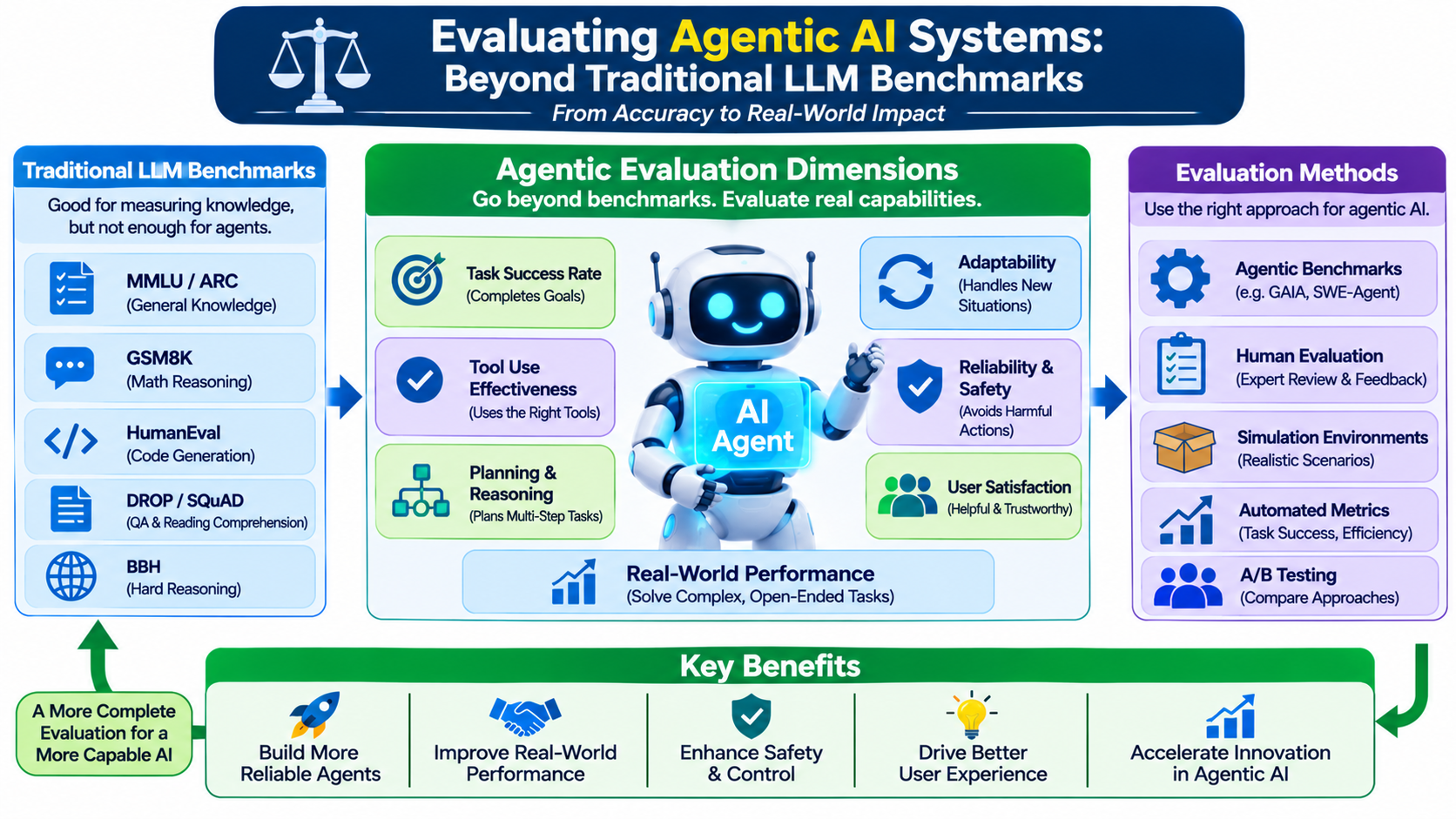
Introduction
Traditional LLM evaluation often focuses on the quality of generated text.
However, an AI agent does more than generate responses. It can plan tasks, invoke tools, retrieve information, modify state and interact with external systems.
An agent can produce a convincing explanation while failing to complete the actual task.
This makes agent evaluation fundamentally different from evaluating a conventional chatbot.
1. Task Completion Rate
Task completion measures whether the agent successfully achieves the intended objective.
For example, an agent tasked with generating a candidate assessment report should complete all required steps rather than merely describe how the report could be created.
2. Tool Selection Accuracy
An agent may have access to multiple tools.
Tool selection accuracy evaluates whether it chooses the appropriate tool for a given task.
For example, an agent should retrieve employee assessment records rather than perform an unrelated web search.
3. Tool Execution Success
Even when the correct tool is selected, execution may fail because of invalid arguments, API errors or permission restrictions.
Measure successful tool execution separately from tool selection.
4. Trajectory Evaluation
An agent trajectory is the sequence of decisions and actions taken during execution.
Evaluating trajectories helps identify:
Unnecessary tool calls.
Repeated reasoning loops.
Incorrect task decomposition.
Poor delegation.
Missed verification steps.
Unnecessary execution paths.
A successful final response does not always mean the execution process was efficient or safe.
5. Efficiency Metrics
Useful efficiency measurements include:
Number of LLM calls.
Number of tool calls.
Total execution time.
Total token consumption.
Cost per completed task.
Number of retries.
6. Safety and Policy Compliance
Agents with access to external systems must be evaluated for safe behavior.
Important checks include:
Unauthorized tool usage.
Attempts to access restricted information.
Improper handling of confidential data.
Failure to request required approval.
Unsafe actions triggered by untrusted inputs.
Building an Agent Evaluation Dataset
A useful evaluation dataset should contain:
A clearly defined user task.
Expected outcomes.
Available tools and permissions.
Expected or acceptable execution behavior.
Failure conditions.
Evaluation criteria.
Test cases should include normal scenarios, ambiguous requests, adversarial inputs and tool failures.
Offline and Online Evaluation
Offline evaluation tests agents against curated datasets before deployment.
Online evaluation examines real production interactions to detect failures and emerging behavior patterns.
Human feedback can be used to validate automated evaluator decisions and improve evaluation datasets.
Conclusion
Evaluating agentic AI requires measuring both what the system produces and how it achieves its objective.
Task success, tool behavior, execution trajectories, efficiency and safety should all be part of a production evaluation strategy.