LangGraph: Designing Stateful AI Agents and Complex Workflows
Introduction
As AI applications become more sophisticated, simple linear chains are often insufficient.
A production AI agent may need to execute multiple steps, remember previous actions, recover from failures, request human approval and dynamically select different execution paths.
LangGraph addresses these requirements through graph-based orchestration.
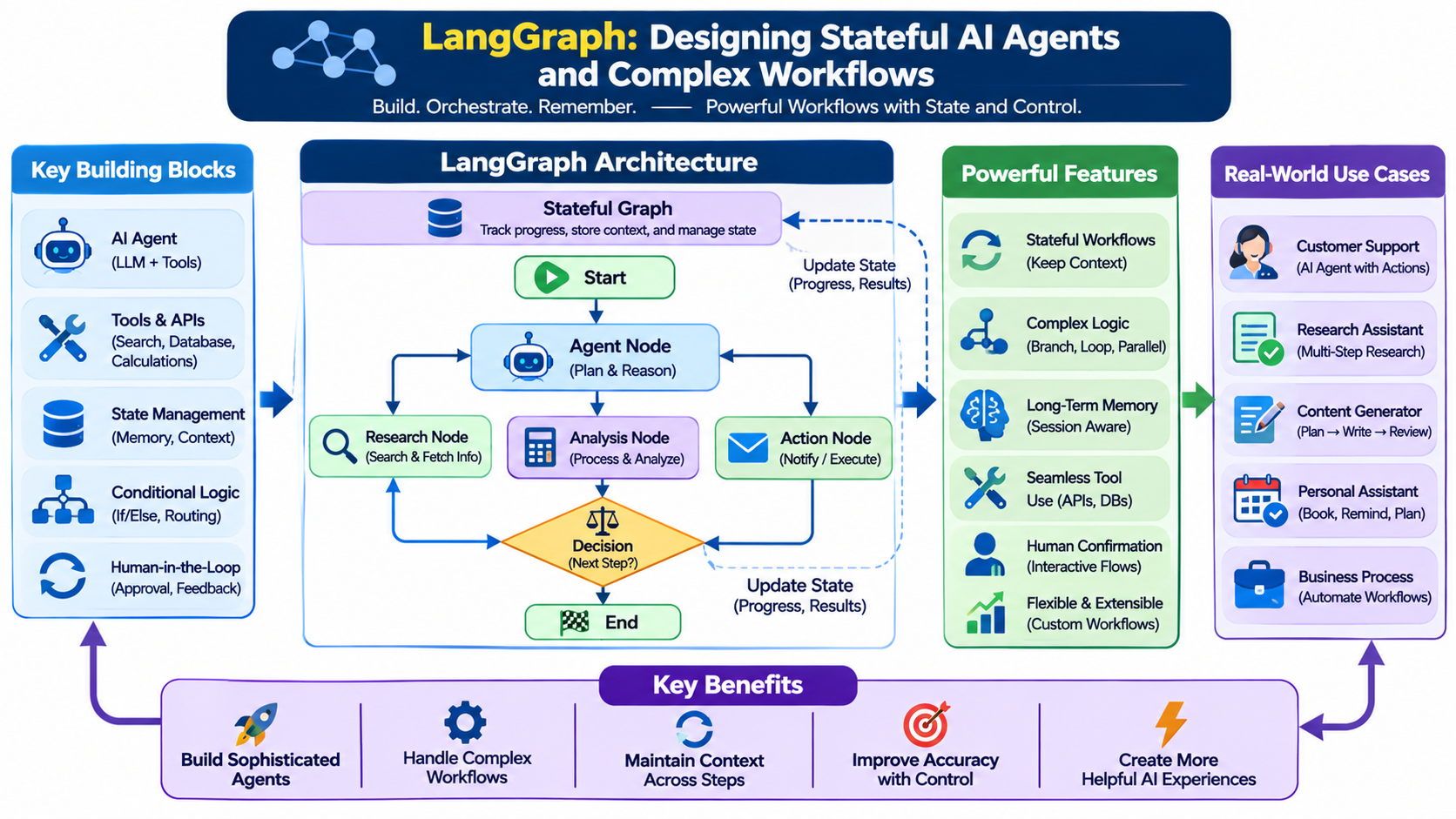
Understanding the Graph Architecture
LangGraph workflows are built around three fundamental concepts.
Nodes
Nodes represent individual operations.
A node might execute an LLM call, retrieve documents, invoke a tool or perform deterministic business logic.
Edges
Edges define how execution moves between nodes.
They can be fixed transitions or conditional transitions based on the current state.
State
State is the shared data structure that carries information throughout the workflow.
It may contain user messages, retrieved documents, execution status, tool outputs and intermediate results.
Building a Stateful Workflow
Consider an AI recruitment assessment application.
A possible workflow:
Receive candidate information.
Analyze the candidate's experience.
Retrieve relevant job requirements.
Generate assessment questions.
Evaluate candidate responses.
Identify knowledge gaps.
Request human review when necessary.
Generate the final assessment report.
Conditional routing allows the system to follow different paths depending on assessment results.
Persistence and Checkpointing
Long-running agents need a way to preserve their progress.
LangGraph persistence uses checkpoints to save graph state.
This supports:
Resuming interrupted workflows.
Maintaining conversation continuity.
Recovering from failures.
Supporting human approval.
Inspecting previous execution states.
Checkpointing is particularly important when an agent performs expensive or time-consuming operations.
Human-in-the-Loop Architecture
Not every decision should be fully automated.
For example, an agent may prepare a report but require an authorized reviewer to approve it before publication.
A human-in-the-loop workflow can pause execution, expose the relevant state, collect an approval or correction and resume processing.
Deterministic and Agentic Workflows
A major architectural advantage is the ability to combine traditional code with LLM-driven decisions.
Use deterministic functions for operations requiring predictable outcomes, such as payment calculations and permission checks.
Use LLM-driven nodes where language understanding, reasoning or flexible decision-making is required.
Conclusion
LangGraph is particularly useful when AI applications need explicit workflow control, persistent state, conditional routing and human oversight.
It allows developers to build agentic systems that are more structured, recoverable and observable than unconstrained tool-calling loops.