Multi-Agent Systems: Architecture, Communication and Orchestration
Introduction
A single AI agent can handle many tasks, but complex problems may benefit from dividing responsibilities across multiple specialized agents.
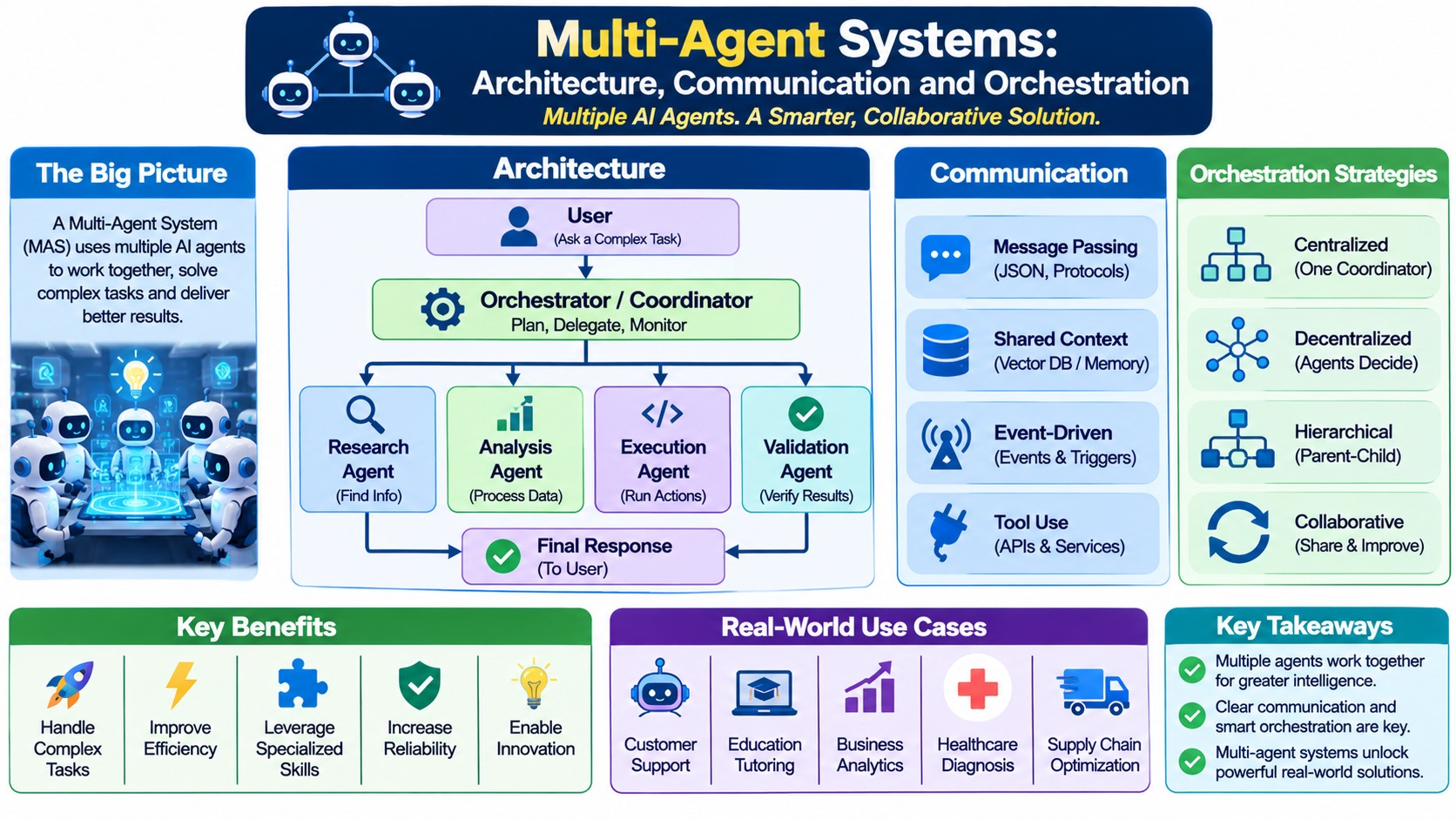
A multi-agent system consists of multiple AI agents that collaborate, delegate tasks or exchange information to achieve a shared objective.
Rather than assigning every responsibility to one general-purpose agent, developers can create specialized agents with distinct roles and tools.
Why Multi-Agent Systems?
Consider an enterprise knowledge assessment platform.
A single agent might be responsible for generating questions, evaluating answers, checking technical accuracy and preparing reports.
A multi-agent architecture can divide these responsibilities:
Research Agent: Retrieves relevant knowledge.
Question Generation Agent: Creates assessment questions.
Evaluation Agent: Evaluates submitted answers.
Validation Agent: Checks consistency and evidence.
Reporting Agent: Produces the final assessment.
Each agent has a defined responsibility.
Common Multi-Agent Architectures
1. Supervisor Architecture
A supervisor agent coordinates specialized agents and decides which agent should handle each task.
This is useful when tasks require dynamic delegation.
2. Hierarchical Architecture
A top-level agent delegates work to intermediate coordinators, which manage specialized agents.
This can support large workflows with multiple layers of responsibility.
3. Sequential Architecture
Agents execute tasks in a predefined order.
The output of one agent becomes the input for the next.
4. Collaborative Architecture
Multiple agents independently analyze a problem and exchange results before producing a final outcome.
This can be useful for research and complex reasoning, although it may increase cost and execution time.
Communication and Shared State
Agents need structured communication.
Useful information includes:
Task identifiers
Assigned responsibilities
Input data
Intermediate outputs
Execution status
Tool results
Error information
Final decisions
A shared state or message-passing architecture can help coordinate these interactions.
Challenges in Multi-Agent Systems
Multi-agent architectures introduce additional complexity.
Coordination failures: Agents may misunderstand task ownership or duplicate work.
Conflicting outputs: Different agents may produce inconsistent conclusions.
Unbounded execution: Agents may repeatedly delegate tasks or invoke tools without reaching completion.
Cost and latency: Multiple model calls can increase execution expenses.
Security: An agent may receive more permissions than its role requires.
When Should You Use Multi-Agent Systems?
Not every application needs multiple agents.
If a workflow is simple and predictable, a single agent or deterministic pipeline may be more efficient.
Multi-agent systems become useful when tasks have clearly separable responsibilities, specialized tools or independent reasoning requirements.
Conclusion
Multi-agent systems offer a powerful way to organize complex AI workflows.
However, success depends on clear responsibilities, controlled communication, execution limits, permission boundaries and measurable outcomes—not simply increasing the number of agents.