Securing RAG and Agentic AI Applications: Prompt Injection, Data Leakage and Access Control
Introduction
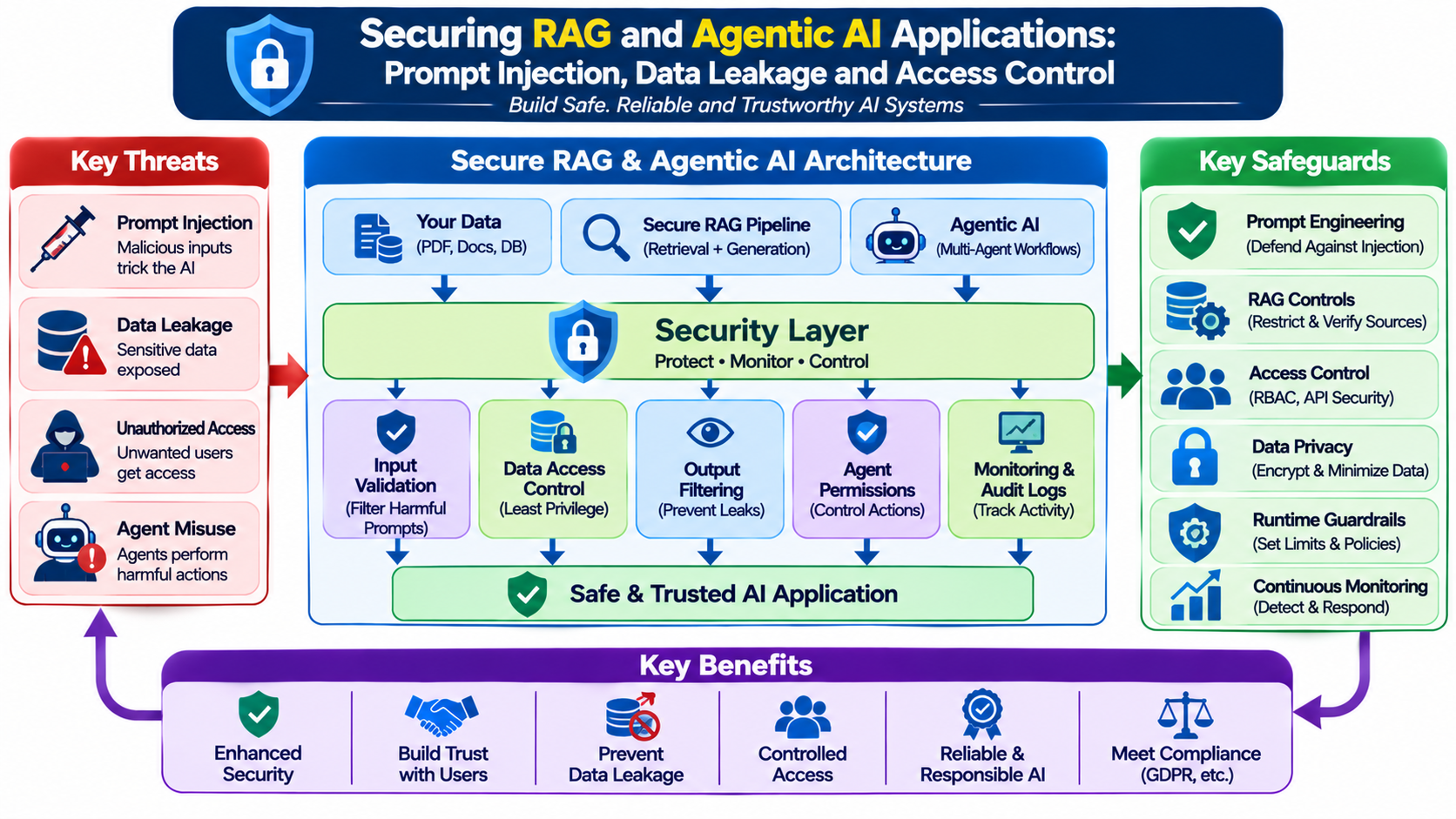
As AI applications gain access to private documents, business databases and external tools, security becomes a fundamental architectural requirement.
A RAG application may retrieve confidential documents, while an AI agent may have permission to send emails, update records or execute business operations.
Without proper safeguards, these capabilities can introduce serious security vulnerabilities.
1. Prompt Injection
Prompt injection occurs when malicious instructions are embedded in user input or external content.
For example, a document retrieved by a RAG system might contain instructions attempting to override the application's intended behavior.
The model may interpret these instructions as part of its context.
Developers should treat retrieved documents, websites and tool outputs as untrusted data.
2. Sensitive Information Disclosure
AI systems may expose information that should remain confidential.
Examples include:
Personal information.
Internal company documents.
API credentials.
Customer records.
Proprietary business information.
Access control should be enforced at the application and data retrieval layers, not merely through system prompts.
3. Data Poisoning
An attacker may introduce manipulated documents into a knowledge base.
These documents can influence retrieval results and cause the model to generate misleading answers.
Document validation, source verification, version management and access restrictions help reduce this risk.
4. Excessive Agent Permissions
An agent should not automatically receive every permission available to the application.
For example, a reporting agent may need read access to assessment records but should not necessarily have permission to delete them.
Apply the principle of least privilege.
5. Secure Tool Execution
Tool calls should be validated independently of model-generated instructions.
Important controls include:
Input schema validation.
Authentication and authorization.
Role-based access control.
Rate limits.
Action allowlists.
Human approval for sensitive operations.
Audit logging.
6. Secure RAG Architecture
A secure RAG pipeline should include:
Document source validation.
Permission-aware document ingestion.
Secure embedding and vector storage.
User-specific retrieval filtering.
Context isolation.
Output validation.
Citation and source verification.
Audit logging.
Filtering results after retrieval is not always sufficient. Authorization should be enforced before restricted information is exposed to the generation model.
7. Security Testing
AI applications should be tested against malicious prompts, unauthorized retrieval attempts, manipulated documents, unsafe tool arguments and data leakage scenarios.
The OWASP Top 10 for LLM and Generative AI applications provides a useful framework for understanding major risk categories.
Conclusion
Securing an AI application requires more than writing a strong system prompt.
RAG systems and agents need layered security involving identity, permissions, data protection, input validation, tool restrictions and continuous testing.
Organizations should treat AI security as part of the complete application architecture rather than an optional feature.